
Philippines
Singapore and the Philippines enjoy warm and longstanding bilateral relations, underpinned by strong trade and investment flows and extensive business links. Our economic partnership is supported by ASEAN economic agreements and the Regional Comprehensive Economic Partnership (RCEP).
Last updated on 12 November 2026
Singapore-Philippines Economic Relations
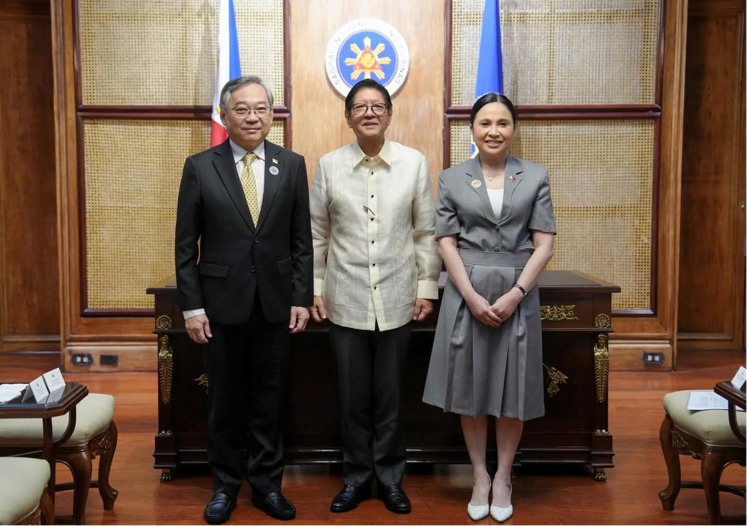
Deputy Prime Minister and Minister for Energy, Trade and Industry (Trade) Gan Kim Yong called on Filipino President Ferdinand R. Marcos Jr. on the sidelines of the 32nd ASEAN Economic Ministers Retreat in March 2026. They are accompanied by Filipino Secretary of Trade and Industry, Ma. Cristina Aldeguer-Roque.
Singapore and the Philippines concluded an MOU on carbon credits collaboration in August 2024, which provides a platform for further cooperation in carbon markets and sustainable development. This partnership was strengthened through the signing of an Implementation Agreement (IA) in April 2026 to operationalise the MOU.
Both sides also collaborate on issues at ASEAN, the World Trade Organization (WTO), and the Asia-Pacific Economic Cooperation (APEC).
Plurilateral Agreements involving the Philippines
ASEAN Economic Agreements
Singapore and the Philippines cooperate through a range of ASEAN economic agreements. These agreements support trade, investment, services, connectivity, and economic integration across the region.
Regional Comprehensive Economic Partnership (RCEP)
The Regional Comprehensive Economic Partnership (RCEP) is the world’s largest FTA, comprising about 30% of global GDP and about a third of the world’s population. It broadens and deepens Singapore’s economic connectivity with the region, opens up opportunities and provides businesses with more coherent access to the region.
International Platforms involving the Philippines
Association of Southeast Asian Nations (ASEAN)
The Association of Southeast Asian Nations (ASEAN) consists of 11 member states following the official admission of Timor-Leste. The members are Brunei, Cambodia, Indonesia, Laos, Malaysia, Myanmar, Philippines, Singapore, Thailand, Viet Nam, and Timor-Leste. These nations work together to promote economic growth, social progress, and regional stability in Southeast Asia.
Asia Pacific Economic Cooperation (APEC)
The Asia-Pacific Economic Cooperation (APEC) forum comprises 21 Asia-Pacific economies. It was established in 1989 in response to the growing interdependence among Asia-Pacific economies and the advent of regional trade blocs in other parts of the world. Its primary purpose is to promote economic growth and prosperity in the Asia-Pacific region. Singapore was a founding member alongside 11 other economies.
Indo-Pacific Economic Framework for Prosperity (IPEF)
The Indo-Pacific Economic Framework for Prosperity (IPEF) provides a platform for countries in the region to collaborate on advancing resilient, sustainable, and inclusive economic growth, and aims to contribute to cooperation, stability, and prosperity in the region.