
Brazil
Singapore and Brazil share longstanding and robust economic relations, underpinned by trade and investment linkages and expanding business cooperation. Our economic partnership is supported by the MERCOSUR-Singapore Free Trade Agreement (MCSFTA).
Last updated on 12 November 2026
Singapore-Brazil Economic Relations
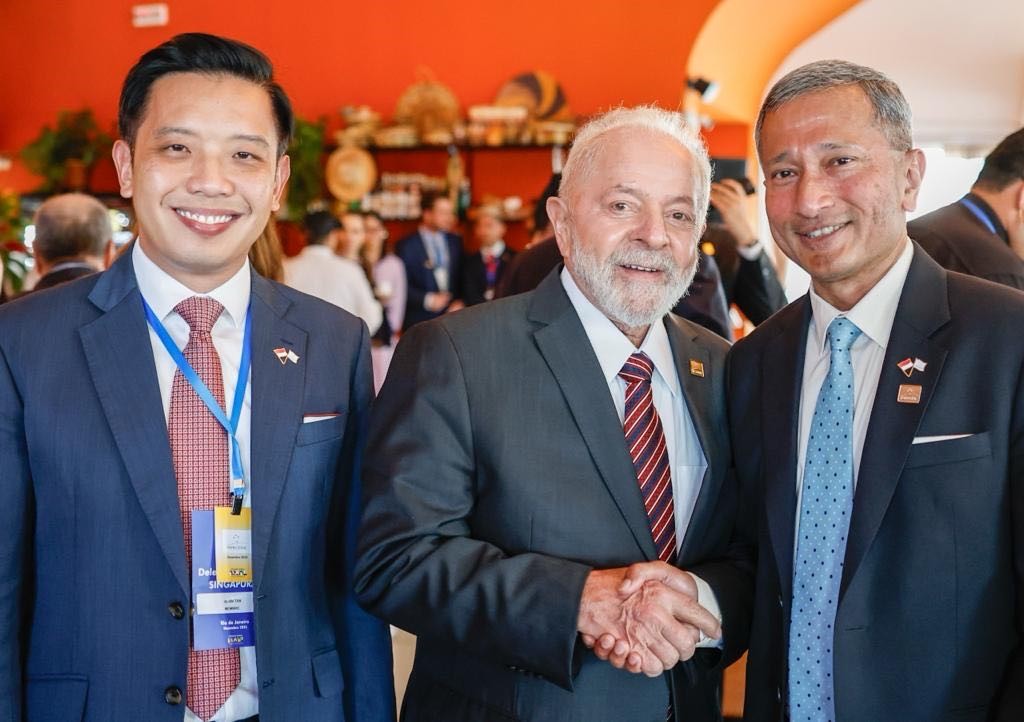
Minister for Foreign Affairs Dr Vivian Balakrishnan and then-Minister of State for Energy, Trade and Industry Alvin Tan with Brazil President Luiz Inácio Lula da Silva, on the sidelines of the signing ceremony for the MERCOSUR-Singapore Free Trade Agreement (MCSFTA) in Rio de Janeiro, 7 December 2023.
Singapore's economic linkages with Brazil are underpinned by cooperation and trade flows in various key sectors.
Singapore and Brazil are connected through the MERCOSUR-Singapore Free Trade Agreement (MCSFTA) which entered into force between Singapore and Brazil on 1 August 2026. This will be the first FTA that Singapore has with Brazil, and will lead to deeper economic engagement between both markets.
Recent high-level visits include Prime Minister Lawrence Wong’s visit to Brazil in November 2024 for the Group of Twenty (G20) Summit and Deputy Prime Minister and Minister for Energy, Trade and Industry Gan Kim Yong’s visit to Brazil for the G20 Trade and Investment Ministerial Meeting.
Bilateral Agreements involving Brazil
Singapore-Brazil Avoidance of Double Taxation Agreement (DTA)
The Singapore-Brazil Avoidance of Double Taxation Agreement (DTA) entered into force on December 1, 2021, and reduces withholding taxes and cross-border tax barriers between both nations.
Plurilateral Agreements involving Brazil
MERCOSUR-Singapore FTA (MCSFTA)
The MCSFTA is the first trade deal between the MERCOSUR Member States and Singapore. Upon its entry into force, the MCSFTA will deepen economic integration between Singapore and the four South American economies by facilitating greater trade flows through lower tariff rates, establishing transparent and predictable investment conditions, and fostering cooperation in areas such as trade facilitation, food supply security, digitalisation, and SME development.