
Chile
Singapore and Chile share longstanding and robust economic relations. We are connected through the Comprehensive and Progressive Agreement for Trans-Pacific Partnership (CPTPP), the Digital Economy Partnership Agreement (DEPA), and the Pacific Alliance-Singapore Free Trade Agreement (PASFTA).
Last updated on 12 November 2026
Singapore-Chile Economic Relations
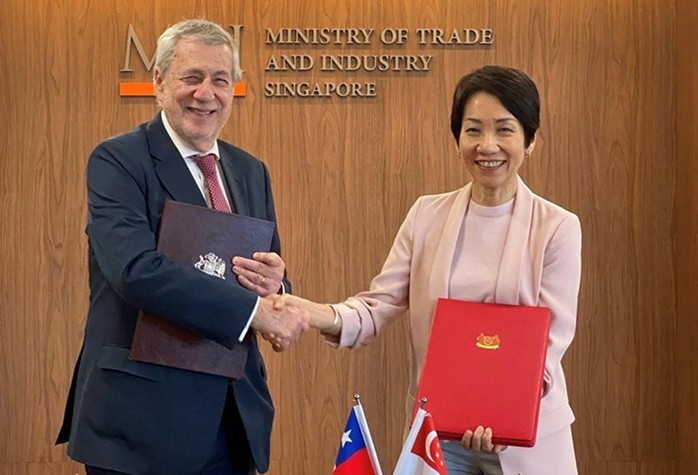
Minister for Sustainability and the Environment and Minister-in-charge of Trade Relations Grace Fu and Chile’s Minister of Foreign Affairs Alberto van Klaveren signed an implementation agreement to collaborate on carbon credits in Singapore, 7 April 2025.
Singapore and Chile are connected through the Comprehensive and Progressive Agreement for Trans-Pacific Partnership (CPTPP), the Digital Economy Partnership Agreement (DEPA), and the Pacific Alliance-Singapore Free Trade Agreement (PASFTA). These platforms deepen our economic engagement with Chile, give companies greater access to each other’s markets, and pave the way for further areas of bilateral cooperation.
Bilateral Agreements involving Chile
Singapore-Chile Implementation Agreement (IA) on carbon credits cooperation
Singapore and Chile signed an Implementation Agreement on carbon credits cooperation on 7 April 2025.
Plurilateral Agreements involving Chile
Digital Economy Partnership Agreement (DEPA)
The DEPA is the world’s first-ever standalone digital trade agreement. It establishes new approaches and collaborations in digital trade issues, promotes interoperability between different regimes, and addresses emerging digital technology issues such as artificial intelligence (AI).
Pacific Alliance-Singapore Free Trade Agreement (PASFTA)
The Pacific Alliance comprises of Chile, Colombia, Mexico and Peru. The PASFTA entered into force between Singapore, Chile and Peru in May 2025. It is currently pending Colombia and Mexico’s ratification.
Trans-Pacific Strategic Economic Partnership (TPSEP)
The Trans-Pacific Strategic Economic Partnership (TPSEP), also known as Pacific-4 (P4), is a Free Trade Agreement between Brunei Darussalam, Chile, New Zealand, and Singapore. It was signed in 2005 and entered into force in 2006.
Comprehensive and Progressive Agreement for Trans-Pacific Partnership (CPTPP)
The CPTPP Agreement contains commitments aimed at easing and growing trade and investment among its members. This includes eliminating tariffs on 94 to 99% of trade in goods, reducing non-tariff barriers, easing services and investment regulations, and establishing digital trade rules, among others. The CPTPP members collectively represent approximately 15% of global GDP.
International Platforms involving Chile
Future of Investment and Trade (FIT) Partnership
The FIT Partnership is a grouping of 20 small and medium-sized, trade-dependent countries located across different regions and geographies that seeks to advocate for open, predictable, rules-based and fair trade, enhance investment flows, and facilitate collaborative solutions which are vital to their prosperity and growth.
Asia-Pacific Economic Cooperation (APEC)
The Asia-Pacific Economic Cooperation (APEC) forum comprises 21 Asia-Pacific economies. It was established in 1989 in response to the growing interdependence among Asia-Pacific economies and the advent of regional trade blocs in other parts of the world. Its primary purpose is to promote economic growth and prosperity in the Asia-Pacific region. Singapore was a founding member alongside 11 other economies.