
Australia
Singapore and Australia share a longstanding and multifaceted partnership grounded in decades of mutual confidence and a Comprehensive Strategic Partnership. Our economic partnership is supported by the Singapore-Australia Free Trade Agreement (SAFTA) and cooperation in the green economy, digital economy and supply chain resilience.
Last updated on 12 November 2026
Singapore-Australia Economic Relations
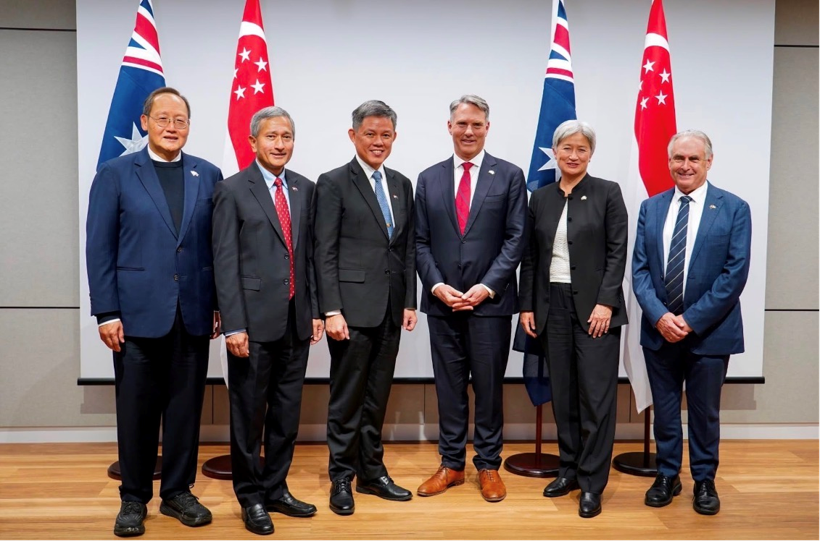
Minister for Energy, Trade and Industry (Energy and Industry) Dr Tan See Leng, Minister for Defence Chan Chun Sing and Minister for Foreign Affairs Dr Vivian Balakrishnan with their Australian counterparts in Adelaide for the 15th Meeting of the Singapore-Australia Joint Ministerial Committee (SAJMC) on 27 July 2026.
Our cooperation with Australia deepened significantly with the launch of a Comprehensive Strategic Partnership (CSP) in 2015. In 2025, marking 60 years of diplomatic ties and 10 years of the CSP, both countries agreed to further elevate the partnership. The upgraded CSP expands collaboration in areas central to our future growth, including trade and investment, supply chain resilience, net-zero transition, and science and innovation.
Our institutional platforms reflect the strength of this cooperation. The Annual Leaders’ Meeting (ALM) brings our Prime Ministers together every year to review progress and set new directions. Every 18 months, our Foreign, Trade and Defence Ministers meet at the biennial Singapore-Australia Joint Ministerial Committee (SAJMC) to advance bilateral cooperation and exchange views on regional and global developments.
Singapore and Australia signed the Protocol to the Singapore-Australia Free Trade Agreement on Economic Resilience and Essential Supplies on 27 July 2026. The Protocol reflects both countries’ commitment to supply chain resilience and the priority that Singapore and Australia accord to each other with respect to trade in essential supplies.
Singapore and Australia are also close partners in key plurilateral and multilateral economic forums. We work closely at international platforms such as the World Trade Organization (WTO), the Asia-Pacific Economic Cooperation (APEC) and plurilateral ones like the Comprehensive and Progressive Agreement for Trans-Pacific Partnership (CPTPP) to champion open and rules-based trade and deepen regional integration.
Bilateral Agreements involving Australia
Singapore-Australia Free Trade Agreement (SAFTA)
The Singapore – Australia Free Trade Agreement (SAFTA) was signed in July 2003. It eliminates tariffs for all of Singapore’s exports to Australia. It safeguards market access, ensures a more predictable operating environment for service suppliers, and provides protection for Singapore investors and investments in Australia. SAFTA also adopts a self-certification process and includes a full schedule of product-specific rules of origin in the Rules of Origin chapter.
Protocol to the Singapore-Australia Free Trade Agreement on Economic Resilience and Essential Supplies
The Protocol was signed on 27 July 2026 and reflects the priority we accord each other with respect to trade in essential supplies including petroleum oils, such as diesel, and liquefied natural gas.
Singapore-Australia Digital Economy Agreement (SADEA)
The Singapore-Australia Digital Economy Agreement (SADEA) is Singapore’s second Digital Economy Agreement and entered into force in December 2020.
The SADEA enhances existing digital trade arrangements between Singapore and Australia under the Singapore-Australia Free Trade Agreement. It also includes eight Memoranda of Understanding (MOUs) to operationalise some of the modules in the DEA by identifying or mapping collaboration projects, specifically in the areas of AI, Data Innovation, Digital Identities, Personal Information Protection, E-invoicing, Trade Facilitation, E-certification on Agricultural Commodities and Consumer Protection.
Singapore Australia Green-Economy Agreement (SAGEA)
The SAGEA was Singapore's first Green Economy Agreement and the world's first agreement of its kind.
The SAGEA fosters common rules and standards to (i) promote trade and investment in environmental goods and services, (ii) develop interoperable policy frameworks to support new green growth sectors and (iii) catalyse technology development and cooperative projects in the emerging green economy.
Plurilateral Agreements involving Australia
ASEAN-Australia-New Zealand Free Trade Area (AANZFTA)
The ASEAN-Australia-New Zealand Free Trade Area (AANZFTA) is an FTA between ASEAN Member States, Australia, and New Zealand. The AANZFTA was upgraded in August 2023 and entered into force on 21 April 2025. It contains newer provisions, on supply chain resilience, ecommerce, and a standalone Chapter on Trade and Sustainable Development. Enhanced commitments were made in e-commerce, rules of origin, investment, services, consumer protection, and government procurement.
Comprehensive and Progressive Agreement for Trans-Pacific Partnership (CPTPP)
The Comprehensive and Progressive Agreement for Trans-Pacific Partnership (CPTPP) Agreement contains commitments aimed at easing and growing trade and investment among its members. This includes eliminating tariffs on 94 to 99% of trade in goods, reducing non-tariff barriers, easing services and investment regulations, and establishing digital trade rules, among others. The CPTPP members collectively represent approximately 15% of global GDP.
Regional Comprehensive Economic Partnership (RCEP)
The Regional Comprehensive Economic Partnership (RCEP) is the world’s largest FTA, comprising about 30% of global GDP and about a third of the world’s population. It broadens and deepens Singapore’s economic connectivity with the region, opens up opportunities and provides businesses with more coherent access to the region.
International Platforms involving Australia
Asia Pacific Economic Cooperation (APEC)
The Asia-Pacific Economic Cooperation (APEC) forum comprises 21 Asia-Pacific economies. It was established in 1989 in response to the growing interdependence among Asia-Pacific economies and the advent of regional trade blocs in other parts of the world. Its primary purpose is to promote economic growth and prosperity in the Asia-Pacific region. Singapore was a founding member alongside 11 other economies.
Indo-Pacific Economic Framework for Prosperity (IPEF)
The Indo-Pacific Economic Framework for Prosperity (IPEF) provides a platform for countries in the region to collaborate on advancing resilient, sustainable, and inclusive economic growth, and aims to contribute to cooperation, stability, and prosperity in the region.