
Brunei Darussalam
Singapore and Brunei share an excellent and longstanding relationship, anchored by deep political, social and historical ties. Our economic partnership is supported by ASEAN economic agreements, the Comprehensive and Progressive Agreement for Trans-Pacific Partnership (CPTPP), the Regional Comprehensive Economic Partnership (RCEP), and the Trans-Pacific Strategic Economic Partnership (P4).
Last updated on 12 November 2026
Singapore-Brunei Economic Relations
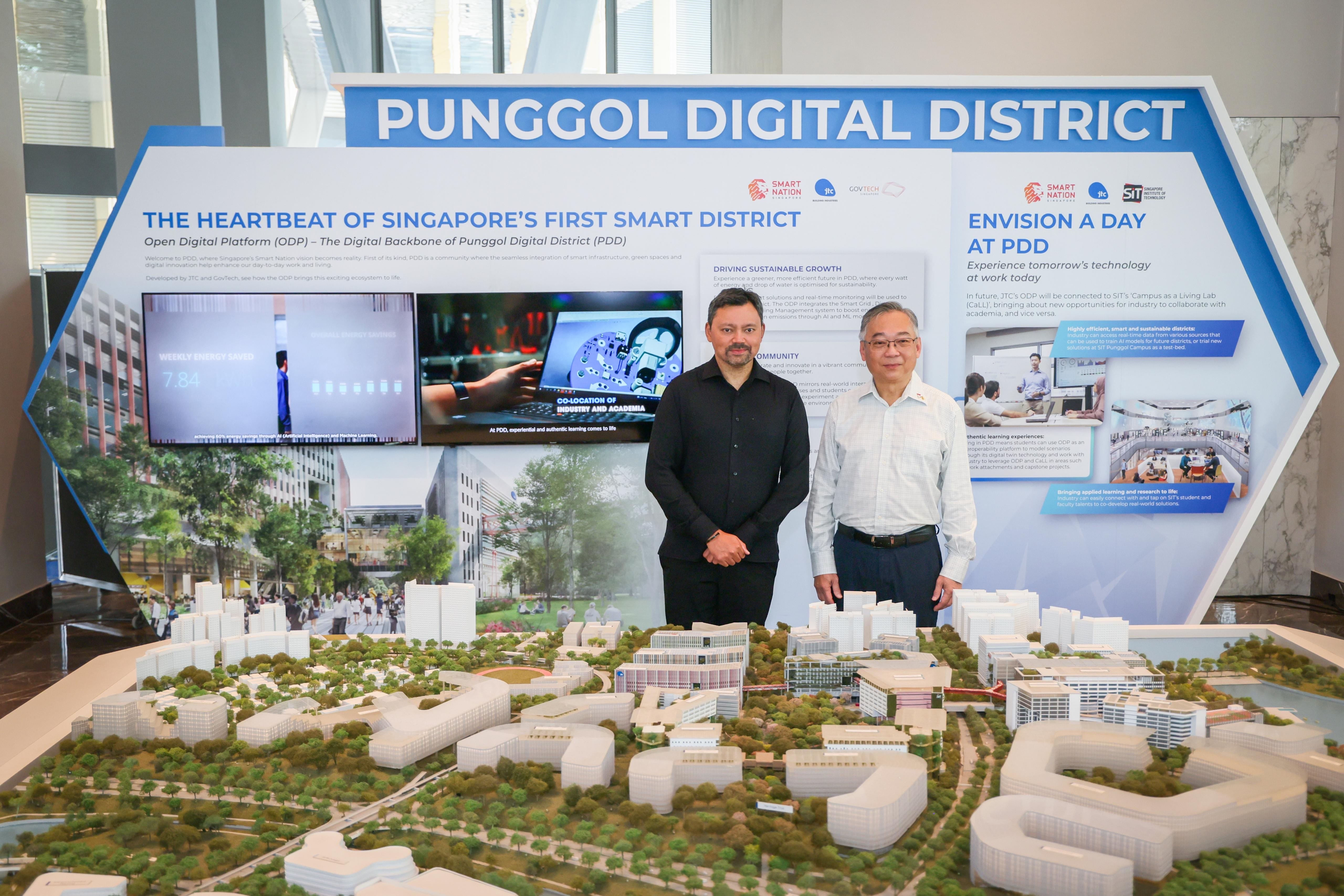
Deputy Prime Minister and Minister for Energy, Trade and Industry (Trade) Gan Kim Yong with Brunei Crown Prince and Senior Minister Al-Muhtadee Billah at a Punggol Digital District showcase during the latter’s visit to Singapore for the 12th Young Leaders Programme in October 2026.
Singapore and Brunei Ministers and Officials meet regularly for the Joint Committee Meeting (JCM), to advance economic cooperation in areas such as (i) Food Supply, (ii) Medical Products, (iii) Low Carbon Energy; and (iv) Carbon Markets and Carbon Capture and Storage.
Singapore and Brunei are also close partners in key plurilateral and multilateral economic forums, including ASEAN. We work closely at international platforms such as the World Trade Organization (WTO), the Asia-Pacific Economic Cooperation (APEC) and plurilateral ones like the Comprehensive and Progressive Agreement for Trans-Pacific Partnership (CPTPP) to champion open and rules-based trade and deepen regional integration.
Plurilateral Agreements involving Brunei
ASEAN Economic Agreements
Singapore and Brunei cooperate through a range of ASEAN economic agreements. These agreements support trade, investment, services, connectivity, and economic integration across the region.
Comprehensive and Progressive Agreement for Trans-Pacific Partnership (CPTPP)
The Comprehensive and Progressive Agreement for Trans-Pacific Partnership (CPTPP) Agreement contains commitments aimed at easing and growing trade and investment among its members. This includes eliminating tariffs on 94 to 99% of trade in goods, reducing non-tariff barriers, easing services and investment regulations, and establishing digital trade rules, among others. The CPTPP members collectively represent approximately 15% of global GDP.
Regional Comprehensive Economic Partnership (RCEP)
The Regional Comprehensive Economic Partnership (RCEP) is the world’s largest FTA, comprising about 30% of global GDP and about a third of the world’s population. It broadens and deepens Singapore’s economic connectivity with the region, opens up opportunities and provides businesses with more coherent access to the region.
Trans-Pacific Strategic Economic Partnership (TPSEP)
The Trans-Pacific Strategic Economic Partnership (TPSEP), also known as Pacific-4 (P4), is a Free Trade Agreement between Brunei Darussalam, Chile, New Zealand, and Singapore. It was signed in 2005 and entered into force in 2006.
International Platforms Involving Brunei
Association of Southeast Asian Nations (ASEAN)
The Association of Southeast Asian Nations (ASEAN) consists of 11 member states following the official admission of Timor-Leste. The members are Brunei, Cambodia, Indonesia, Laos, Malaysia, Myanmar, Philippines, Singapore, Thailand, Viet Nam, and Timor-Leste. These nations work together to promote economic growth, social progress, and regional stability in Southeast Asia.
Asia Pacific Economic Cooperation (APEC)
The Asia-Pacific Economic Cooperation (APEC) forum comprises 21 Asia-Pacific economies. It was established in 1989 in response to the growing interdependence among Asia-Pacific economies and the advent of regional trade blocs in other parts of the world. Its primary purpose is to promote economic growth and prosperity in the Asia-Pacific region. Singapore was a founding member alongside 11 other economies.
Indo-Pacific Economic Framework for Prosperity (IPEF)
The Indo-Pacific Economic Framework for Prosperity (IPEF) provides a platform for countries in the region to collaborate on advancing resilient, sustainable, and inclusive economic growth, and aims to contribute to cooperation, stability, and prosperity in the region.
Future of Investment and Trade Partnership (FIT-P)
The Future of Investment and Trade Partnership (FIT-P) is a grouping of 20 small and medium-sized, trade-dependent countries located across different regions and geographies that seeks to advocate for open, predictable, rules-based and fair trade, enhance investment flows, and facilitate collaborative solutions which are vital to their prosperity and growth.