
Indo-Pacific Economic Framework (IPEF)
The Indo-Pacific Economic Framework for Prosperity (IPEF) provides a platform for countries in the region to collaborate on advancing resilient, sustainable, and inclusive economic growth, and aims to contribute to cooperation, stability, and prosperity in the region.
Last updated on 12 November 2026
About IPEF
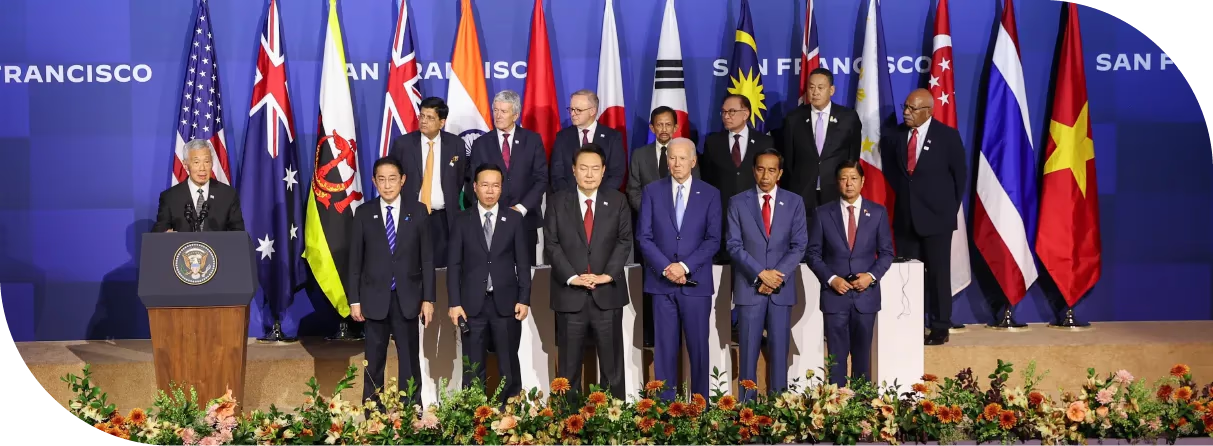
The Indo-Pacific Economic Framework for Prosperity (IPEF) was launched on 23 May 2022 and currently includes 14 partners - Australia, Brunei Darussalam, Fiji, India, Indonesia, Japan, Republic of Korea, Malaysia, New Zealand, Philippines, Singapore, Thailand, the United States and Viet Nam. It provides a platform for countries in the region to collaborate on advancing resilient, sustainable, and inclusive economic growth, and aims to contribute to cooperation, stability, and prosperity in the region. Read more on then-Prime Minister Lee Hsien Loong’s intervention at the Leaders’ launch of the IPEF (opens in new tab)and the Leaders’ Statement issued at the launch (opens in new tab).
An IPEF Leaders event was held on 16 November 2023 in San Francisco, US, during which the Leaders announced that they would meet once every two years, launched an IPEF Critical Minerals Dialogue, and agreed to explore additional cooperative initiatives in areas such as energy security, technology and people-to-people ties. Read more on then-Prime Minister Lee Hsien Loong’s remarks at the event (opens in new tab) and the Leaders’ Statement issued at the event (opens in new tab).
Leaders & Ministerial meetings
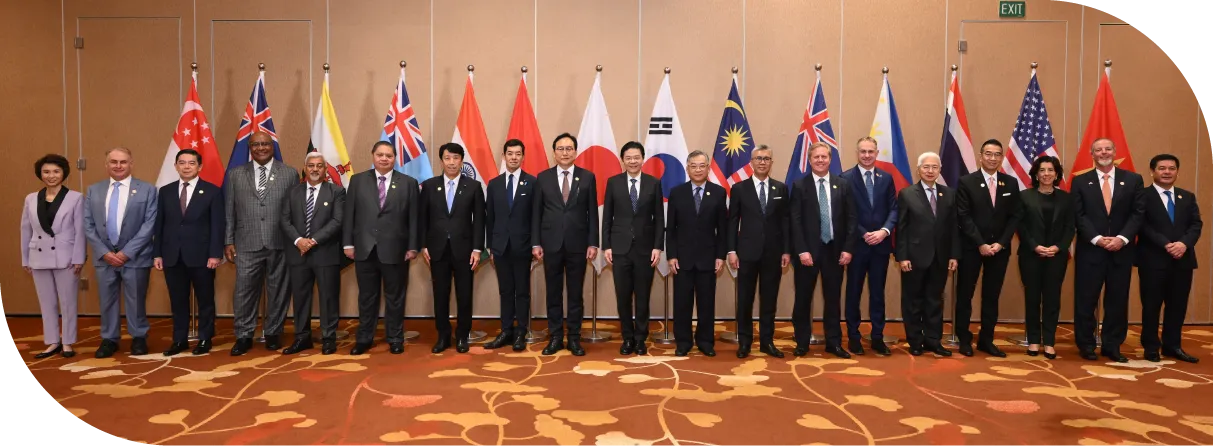
Leaders' Meetings
Ministerial Meetings
Singapore, 6 June 2024 [PDF, 587 KB] (opens in new tab); held alongside the inaugural Clean Economy Investor Forum from 5 - 6 June 2024
Virtual Ministerial Meeting, 14 March 2024 (opens in new tab)
San Francisco, US, 16 November 2023 [PDF, 1.1 MB] (opens in new tab)
IPEF Pillars and Agreements
IPEF Pillars and Agreements
Four pillars of cooperation
The IPEF comprises four pillars of cooperation outlined in the Ministerial Statements issued on 9 September 2022, namely Trade, Supply Chain, Clean Economy, and Fair Economy:
Negotiations on the Agreement for the Trade pillar are ongoing;
The Supply Chain Agreement was signed in November 2023, and entered-into-force on 24 February 2024 following ratification by Japan, the US, Singapore, Fiji and India;
The Clean Economy Agreement was signed in June 2024;
The Fair Economy Agreement was signed in June 2024.
In addition, IPEF partners have signed an Agreement on the IPEF which will establish an IPEF Ministerial Council as well as a Ministerial Joint Commission. To find out more, download the IPEF Overarching Agreement [PDF, 187 KB] (opens in new tab).
Trade pillar
Negotiations on the Trade pillar are ongoing.
IPEF partners will seek to develop high-standard, inclusive, free, fair, and open trade commitments that build upon the rules-based multilateral trading system and develop new and creative approaches to trade and technology policies in the areas of: labour; the environment; the digital economy; agriculture; transparency and good regulatory practices; competition policy; trade facilitation; inclusivity; and technical assistance and economic cooperation.
To find out more, read the Ministerial Statement [PDF, 143 KB] (opens in new tab).
Supply Chain Agreement
The Supply Chain Agreement entered-into-force on 24 February 2024 following announcements from Japan, the US, Singapore, Fiji and India that they had completed their domestic processes necessary to become Parties to the Agreement. Since then, the Republic of Korea, Thailand and Malaysia have also become Parties to the Agreement. The Supply Chain Agreement had been signed by all 14 IPEF partners on 14 November 2023, after negotiations were substantially concluded on 27 May 2023 – the first IPEF Agreement to be concluded.
The Supply Chain Agreement establishes the first multi-country arrangement to strengthen the resilience and connectivity of supply chains through collective and individual actions. Three coordination bodies will be established to advance cooperation among IPEF countries: (a) a Supply Chain Council that will develop sector-specific action plans to strengthen resilience in critical sectors and key goods; (b) a Crisis Response Network to facilitate emergency communications and coordination between governments during supply chain disruptions; and (c) a tripartite Labour Rights Advisory Board that will help promote labour rights in IPEF countries’ supply chains.
Partners are currently working to set up the Agreement’s three coordination bodies.
To find out more, download the Supply Chain Agreement [PDF, 240 KB] (opens in new tab).
Clean Economy Agreement
The Clean Economy Agreement was signed on 6 June 2024, after negotiations were substantially concluded on 14 November 2023.
The Clean Economy Agreement will advance regional cooperation to accelerate deployment of clean energy technology, develop offshore electricity infrastructure for cross-border electricity trade, promote carbon market activities, collaborate on regional and international Carbon Capture, Utilisation and Storage (CCUS) value chains, and promote sustainable transport, amongst others.
To find out more, download the Clean Economy Agreement [PDF, 319 KB] (opens in new tab).
Benefits of Clean Economy Agreement
A. Cooperative Work Programmes
The Clean Economy Agreement establishes a novel mechanism for IPEF partners to develop and participate in “Cooperative Work Programmes” (CWPs), which seeks to advance the objectives of the Agreement. To date, a total of eight CWPs have been launched.
The first CWP to be announced was the regional hydrogen initiative in May 2023. The scope of cooperation includes exchanges of information and sharing of best practices on methodologies, standards, and certifications on the carbon intensity of hydrogen and its carriers as well as cross-border pilots and demonstration projects. Since its launch, IPEF partners have taken steps to advance the CWP, which includes organising capacity-building initiatives, establishing workstreams related to the scope, and conducting a supply and demand mapping exercise of the current hydrogen supply chains landscape in the region.
The other CWPs are in the areas of:
Carbon markets, to identify existing regional carbon market priorities and strategies for improving the enabling conditions for cooperation. A two-day Strategic Dialogue was held in April 2024 which focused on regional capacity building for carbon market implementation.
Clean electricity, to facilitate increased decarbonisation and access to clean energy in the region. Participating partners have conducted a mapping exercise and analysis of existing international efforts on clean electricity.
Sustainable aviation fuels (SAF), to enhance the availability and affordability of SAF and its feedstocks, so as to catalyse and develop regional SAF value chains in the region.
Workforce development, to advance employment creation and strengthen efforts to address employment shifts in the transition towards a clean economy.
Emissions intensity accounting, to share information on existing standards, reporting systems and methodologies for the assessment, identification and trade of emerging low emissions products.
E-waste urban mining, to facilitate a more sustainable e-waste management system including through information exchange and activities to develop solutions for the efficient recovery of materials.
Small modular reactors (SMR)s, to support participating partners that are seeking to advance their understanding of SMRs, and where appropriate, introduce SMRs in their countries under the highest standards of safety, security and safeguards.
B. Financing Initiatives
Two financing initiatives have been announced as part of the Clean Economy Agreement.
The first is a US$1.2 billion Climate Fund comprising US$300 million in public financing from the US International Development Finance Corporation (DFC), matched by another US$900 million in private funding by I Squared Capital, a US private equity firm and global infrastructure investment manager. The Climate Fund will be used to invest in climate change mitigation and adaptation, including impactful and sustainable investments across renewable energy, resource recovery, and digital infrastructure, to reduce the carbon footprint of existing infrastructure in emerging markets.
The second is the IPEF Catalytic Capital Fund to pool resources and expand the pipeline of bankable clean economy infrastructure projects. The fund, established by IPEF partners and administered by the Private Infrastructure Development Group (PIDG), aims to deploy concessional financing, technical assistance, and capacity-building support to projects such as lender due diligence, viability gap funding, and other forms of concessional capital in Official Development Assistance (ODA)-eligible countries. A total of US$33 million of initial funding by Australia, Japan, the Republic of Korea, and the United States is in progress and will be set aside to catalyse up to US$3.3 billion in private investment.
C. Clean Economy Investor Forum
The Clean Economy Agreement includes commitments to mobilise investment and sustainable finance to accelerate the transition to clean economies within the Indo-Pacific region. To this end, IPEF partners agreed to establish an annual Investor Forum to catalyse investment for sustainable infrastructure and climate technology projects in the IPEF economies by matching private sector and institutional investors with opportunities in clean economy-related projects in the region.
Singapore hosted the inaugural IPEF Clean Economy Investor Forum (“Investor Forum”) on 6 June 2024 at the Sands Expo and Convention Centre. Organised by the Singapore Ministry of Trade and Industry alongside the 13 other IPEF partners, the full day, by-invite only event successfully gathered over 300 participants which includes the region’s top investors, cutting-edge project proponents, innovative start-up entrepreneurs, Ministers and senior government officials from the 14 IPEF countries, along with other organisations, including philanthropies and multilateral development banks, to build connections, share expertise, exchange ideas, and grow the pipeline of clean technology and infrastructure investments in the region.
At the Investor Forum, the IPEF partners, in partnership with PwC, identified a total of 69 priority infrastructure projects amounting to over US$23 billion of investment opportunities. Of these, 20 investment-ready projects worth about US$6 billion were presented to investors at the business matching sessions. Remaining projects worth about US$17 billion were also identified as potential investment opportunities.
In addition, 49 climate technology startups seeking up to US$2 billion in new funding were invited to pitch to investors. These were identified by HolonIQ from its shortlist of “Indo-Pacific Climate Tech 100” of top climate technology start-ups based in the Indo-Pacific region.
Fair Economy Agreement
The Fair Economy Agreement was signed on 6 June 2024, after negotiations were substantially concluded on 14 November 2023.
The Fair Economy Agreement includes commitments by IPEF partners to strengthen their implementation of anti-corruption measures and taxation initiatives to boost commerce, trade and investment and promote a fair and transparent regional business environment. Partners will enhance their efforts to combat corruption including bribery, and support efforts to improve tax transparency and the exchange of information, domestic resource mobilisation, and tax administration.
During the IPEF Ministerial meeting on 6 June 2024, IPEF Ministers announced a new catalogue of technical assistance and capacity building (TACB) initiatives under the Fair Economy Agreement which seek to support IPEF partner’s implementation of their commitments.
Resources