
Malaysia
Singapore and Malaysia share a longstanding and deeply integrated economic relationship, underpinned by strong trade and investment flows, extensive business links, and close cross-border connectivity. Our economic partnership is supported by ASEAN economic agreements, the Regional Comprehensive Economic Partnership (RCEP), and the Johor-Singapore Special Economic Zone (JS-SEZ).
Last updated on 12 November 2026
Singapore-Malaysia Economic Relations
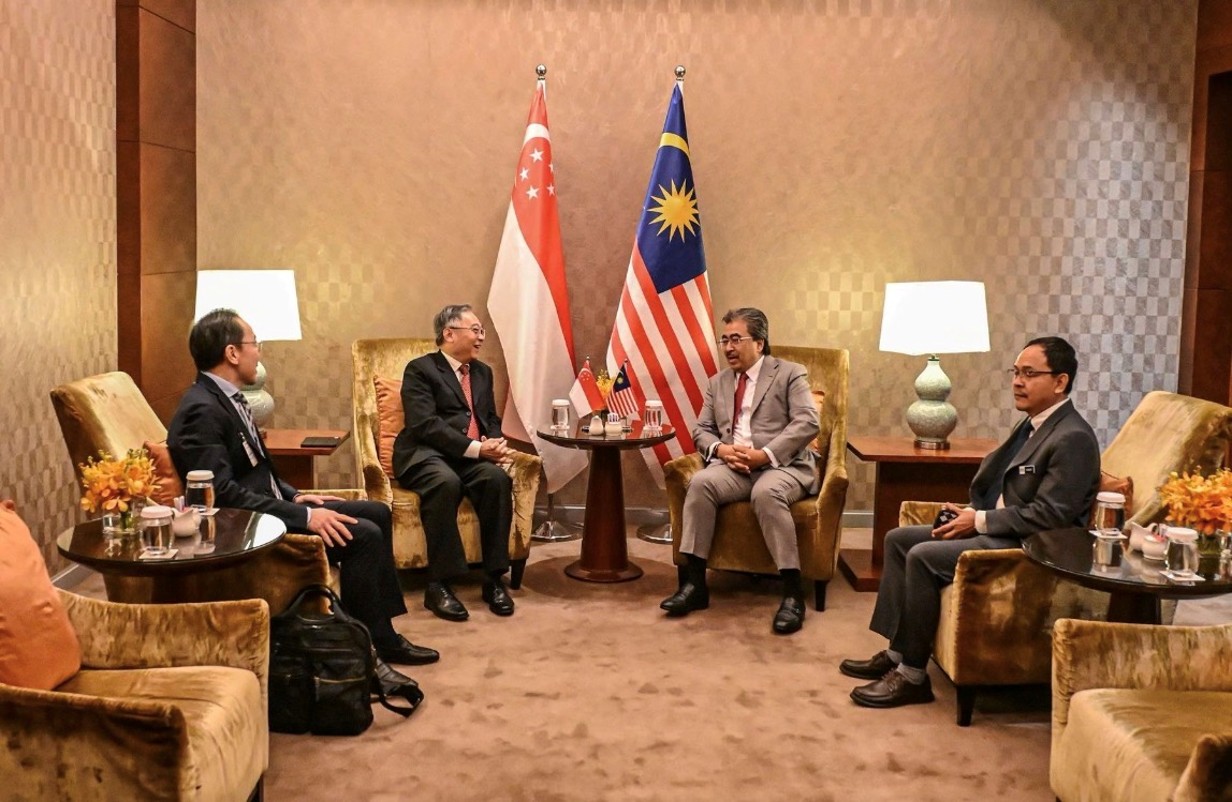
Deputy Prime Minister and Minister for Energy, Trade and Industry Gan Kim Yong and Malaysia Minister of Investment, Trade and Industry Johari Abdul Ghani co-chair the 3rd Annual Ministerial Dialogue (AMD) between METI and Malaysia's Ministry of Investment, Trade and Industry (MITI) on 1 October 2026 in Kuala Lumpur, Malaysia.
Our relationship with Malaysia is anchored through government-to-government platforms like the Annual Ministerial Dialogue (AMD) between METI and Malaysia’s Ministry of Investment, Trade and Industry (MITI), and the Johor-Singapore Cooperation Ministerial Committee (JSCMC).
In January 2025, Singapore and Malaysia signed an agreement on the Johor-Singapore Special Economic Zone (JS-SEZ), which aims to strengthen the value proposition of the Johor-Singapore region by improving the cross-border connectivity of goods and people and strengthening the business ecosystem.
Singapore and Malaysia work together to foster collaboration in new and upcoming sectors. In the green economy, this has included MOUs on Cooperation in the Field of Cross-Border Carbon Capture and Storage (CCS) and on Carbon Credits Cooperation. In the digital economy, we have set up real-time payment systems linkage between Singapore’s PayNow and Malaysia’s DuitNow. Both sides have also established a Supply Chain Cooperation Workgroup in 2024.
Singapore and Malaysia are also close partners in key plurilateral and multilateral economic forums, including ASEAN, the World Trade Organisation (WTO), Asia-Pacific Economic Cooperation (APEC) and the Comprehensive and Progressive Agreement for Trans-Pacific Partnership (CPTPP).
Bilateral Agreements involving Malaysia
Johor – Singapore Special Economic Zone Agreement (JS-SEZ)
Singapore and Malaysia exchanged an Agreement on the Johor-Singapore Special Economic Zone (JS-SEZ) on 7 January 2025.
The JS-SEZ Agreement aims to strengthen the value proposition of Johor and Singapore to compete for global investments together by (a) improving cross-border goods connectivity between Singapore and Johor; (b) enabling freer movement of people; and (c) strengthening the business ecosystem within the region.
Plurilateral Agreements involving Malaysia
ASEAN Economic Agreements
Singapore and Malaysia cooperate through a range of ASEAN economic agreements. These agreements support trade, investment, services, connectivity, and economic integration across the region.
Comprehensive and Progressive Agreement for Trans-Pacific Partnership (CPTPP)
The Comprehensive and Progressive Agreement for Trans-Pacific Partnership (CPTPP) Agreement contains commitments aimed at easing and growing trade and investment among its members. This includes eliminating tariffs on 94 to 99% of trade in goods, reducing non-tariff barriers, easing services and investment regulations, and establishing digital trade rules, among others. The CPTPP members collectively represent approximately 15% of global GDP.
Regional Comprehensive Economic Partnership (RCEP)
The Regional Comprehensive Economic Partnership (RCEP) is the world’s largest FTA, comprising about 30% of global GDP and about a third of the world’s population. It broadens and deepens Singapore’s economic connectivity with the region, opens up opportunities and provides businesses with more coherent access to the region.
International Platforms involving Malaysia
Association of Southeast Asian Nations (ASEAN)
The Association of Southeast Asian Nations (ASEAN) consists of 11 member states following the official admission of Timor-Leste. The members are Brunei, Cambodia, Indonesia, Laos, Malaysia, Myanmar, Philippines, Singapore, Thailand, Viet Nam, and Timor-Leste. These nations work together to promote economic growth, social progress, and regional stability in Southeast Asia.
Asia Pacific Economic Cooperation (APEC)
The Asia-Pacific Economic Cooperation (APEC) forum comprises 21 Asia-Pacific economies. It was established in 1989 in response to the growing interdependence among Asia-Pacific economies and the advent of regional trade blocs in other parts of the world. Its primary purpose is to promote economic growth and prosperity in the Asia-Pacific region. Singapore was a founding member alongside 11 other economies.
Indo-Pacific Economic Framework for Prosperity (IPEF)
The Indo-Pacific Economic Framework for Prosperity (IPEF) provides a platform for countries in the region to collaborate on advancing resilient, sustainable, and inclusive economic growth, and aims to contribute to cooperation, stability, and prosperity in the region.
Future of Investment and Trade Partnership (FIT Partnership)
The FIT Partnership is a grouping of 20 small and medium-sized, trade-dependent countries located across different regions and geographies that seeks to advocate for open, predictable, rules-based and fair trade, enhance investment flows, and facilitate collaborative solutions which are vital to their prosperity and growth.