
Japan
Singapore and Japan enjoy a bilateral relationship that has deepened and broadened over the years, building on regular high-level exchanges and robust economic ties. Our economic partnership is supported by the Japan-Singapore Economic Partnership Agreement (JSEPA), ASEAN-Japan Comprehensive Partnership Agreement (AJCEP), Comprehensive and Progressive Agreement for Trans-Pacific Partnership (CPTPP) and the Regional Comprehensive Economic Partnership (RCEP).
Last updated on 12 November 2026
Singapore-Japan Economic Relations
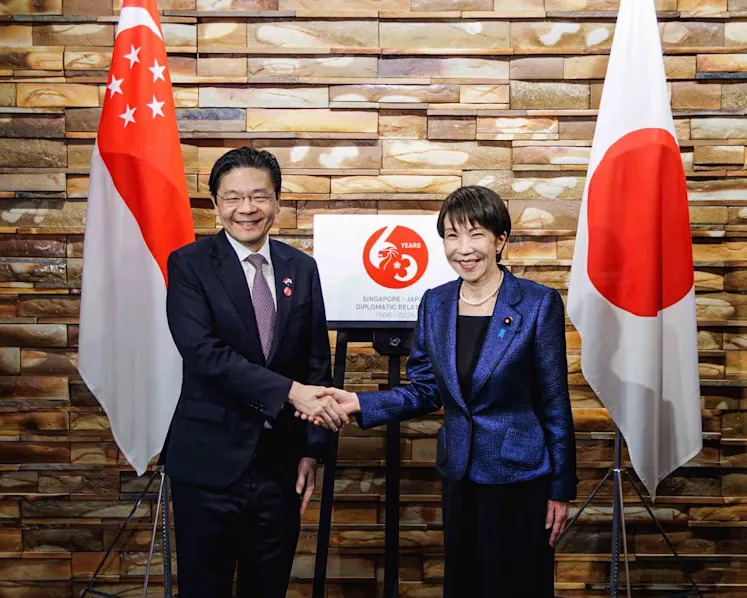
Singapore Prime Minister Lawrence Wong with Japan Prime Minister Sanae Takaichi.
Singapore's economic partnership with Japan is anchored by the Agreement between Japan and the Republic of Singapore for a New-Age Economic Partnership (JSEPA), signed in 2002. JSEPA was Japan’s first bilateral economic partnership agreement and Singapore’s first with a major trading partner.
Singapore and Japan work closely through platforms such as the Comprehensive and Progressive Agreement for Trans-Pacific Partnership (CPTPP), Asia-Pacific Economic Cooperation (APEC), Regional Comprehensive Economic Partnership (RCEP), Indo-Pacific Economic Framework (IPEF), and the Association of Southeast Asian Nations (ASEAN) regional forum.
Bilateral Agreements involving Japan
Japan – Singapore Economic Partnership Agreement (JSEPA)
The Japan-Singapore Economic Partnership Agreement (JSEPA) strengthens bilateral economic relations between Singapore and Japan by broadening market access and fostering a stable, open environment for trade and investment.
Plurilateral Agreements involving Japan
ASEAN-Japan Comprehensive Economic Partnership (AJCEP)
The AJCEP eliminates tariffs for and facilitates trade in goods, services, and investments within ASEAN and Japan.
Regional Comprehensive Economic Partnership (RCEP)
The Regional Comprehensive Economic Agreement (RCEP) is the world’s largest FTA, comprising about 30% of global GDP and about a third of the world’s population. It broadens and deepens Singapore’s economic connectivity with the region, opens up opportunities and provides businesses with more coherent access to the region.
Comprehensive and Progressive Agreement for Trans-Pacific Partnership (CPTPP)
The CPTPP Agreement contains commitments aimed at easing and growing trade and investment among its members. This includes eliminating tariffs on 94 to 99% of trade in goods, reducing non-tariff barriers, easing services and investment regulations, and establishing digital trade rules, among others. The CPTPP members collectively represent approximately 15% of global GDP.
International Platforms involving Japan
Indo-Pacific Economic Framework (IPEF)
The Indo-Pacific Economic Framework for Prosperity (IPEF) provides a platform for countries in the region to collaborate on advancing resilient, sustainable, and inclusive economic growth, and aims to contribute to cooperation, stability, and prosperity in the region.
Asia-Pacific Economic Cooperation (APEC)
The Asia-Pacific Economic Cooperation (APEC) forum comprises 21 Asia-Pacific economies. It was established in 1989 in response to the growing interdependence among Asia-Pacific economies and the advent of regional trade blocs in other parts of the world. Its primary purpose is to promote economic growth and prosperity in the Asia-Pacific region. Singapore was a founding member alongside 11 other economies.