
New Zealand
Singapore and New Zealand share a warm and enduring partnership built on shared values, mutual trust and a commitment to the rules-based trading system. Our economic partnership is supported by the Agreement between New Zealand and Singapore on a Closer Economic Partnership (ANZSCEP) as well as the Agreement on Trade in Essential Supplies (AOTES) between Singapore and New Zealand.
Last updated on 12 November 2026
Singapore-New Zealand Economic Relations
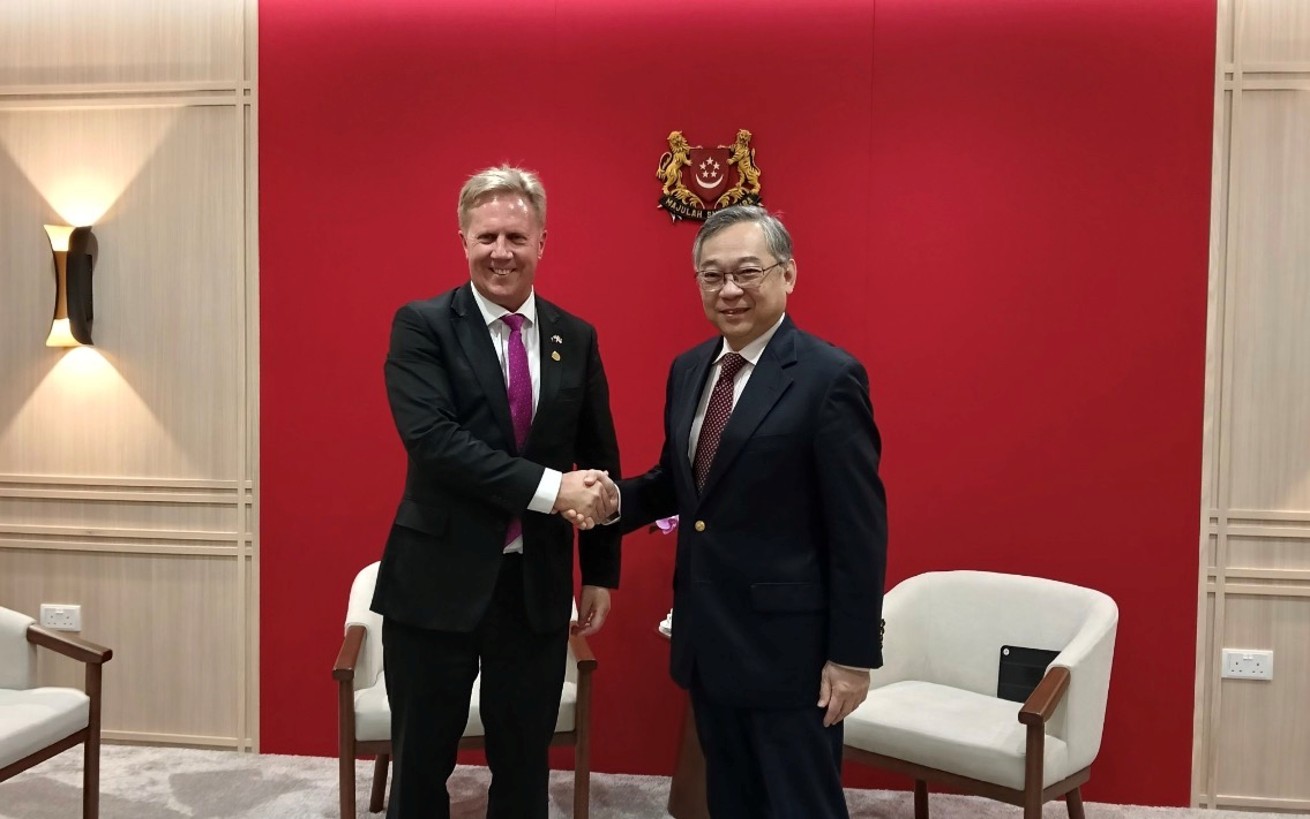
Deputy Prime Minister and Minister for Energy, Trade and Industry Gan Kim Yong with New Zealand Minister for Trade and Industry at a meeting during New Zealand Prime Minister Christopher Luxon's official visit to Singapore on 4 May 2026.
The Agreement between New Zealand and Singapore on a Closer Economic Partnership (ANZSCEP), which is Singapore's first bilateral FTA, was signed in 2000 and upgraded in 2020.
In October 2025, Singapore and New Zealand elevated our bilateral relationship to a Comprehensive Strategic Partnership (CSP) to mark the 60th anniversary of diplomatic relations. The CSP aims to prepare both countries’ economies and societies for challenges and opportunities and extends our cooperation further to engage with our regional partners. It includes strengthened initiatives to be implemented over the next ten years, across six pillars: (i) Trade and Economics; (ii) Defence, Security and Safety; (iii) Science, Technology and Innovation; (iv) People-to-People; (v) Climate Change and Green Economy; and (vi) Supply Chains and Connectivity.
On 4 May 2026, Singapore and New Zealand signed the Agreement on Trade in Essential Supplies (AOTES), the world’s first legally-binding bilateral supply chain resilience agreement. The Agreement entered into force for both sides on 17 July 2026 and reflects both countries’ longstanding commitment to uphold free and unimpeded trade.
Our cooperation with New Zealand is strengthened by regular high-level engagement between our leaders. These exchanges help to advance bilateral collaboration through practical collaboration and exchange views on regional and global issues.
Singapore and New Zealand are close partners in regional and international forums. We work closely on a variety of platforms such as the World Trade Organization (WTO), Asia-Pacific Economic Cooperation (APEC), Comprehensive and Progressive Agreement on Trans-Pacific Partnership (CPTPP) and the Digital Economy Partnership Agreement (DEPA) amongst others.
Singapore and New Zealand are also co-convenors of the Future of Investment and Trade Partnership (FIT Partnership) alongside Switzerland and the United Arab Emirates (UAE).
Bilateral Agreements involving New Zealand
Agreement between New Zealand and Singapore on a Closer Economic Partnership (ANZSCEP)
The Agreement Between New Zealand and Singapore on a Closer Economic Partnership (ANZSCEP) was Singapore’s first bilateral Free Trade Agreement (FTA). It was signed in 2000 and upgraded in 2020. It eliminates all tariffs for Singapore’s exports to New Zealand, allows tariff preference based on the exporter's declaration, safeguards market access, ensures a more predictable operating environment for service suppliers, and provides protection for Singapore investors and investments in Singapore.
Agreement on Trade in Essential Supplies with New Zealand (AOTES)
The Agreement on Trade in Essential Supplies with New Zealand (AOTES) is the world’s first legally-binding bilateral supply chain resilience agreement and entered into force for both sides on 17 July 2026. Under the Agreement, Singapore and New Zealand commit not to impose unnecessary export restrictions on agreed essential supplies, including food, fuel, healthcare, chemical and construction products. The Agreement will provide businesses and consumers on both sides with greater confidence when supply chain disruptions occur.
Plurilateral Agreements involving New Zealand
ASEAN-Australia-New Zealand Free Trade Area (AANZFTA)
The ASEAN-Australia-New Zealand Free Trade Area (AANZFTA) is an FTA between ASEAN Member States, Australia, and New Zealand. The AANZFTA was upgraded in August 2023 and entered into force on 21 April 2025. It contains newer provisions, on supply chain resilience, ecommerce, and a standalone Chapter on Trade and Sustainable Development. Enhanced commitments were made in e-commerce, rules of origin, investment, services, consumer protection, and government procurement.
Comprehensive and Progressive Agreement for Trans-Pacific Partnership (CPTPP)
The Comprehensive and Progressive Agreement for Trans-Pacific Partnership (CPTPP) Agreement contains commitments aimed at easing and growing trade and investment among its members. This includes eliminating tariffs on 94 to 99% of trade in goods, reducing non-tariff barriers, easing services and investment regulations, and establishing digital trade rules, among others. The CPTPP members collectively represent approximately 15% of global GDP.
Digital Economy Partnership Agreement (DEPA)
The DEPA is the world’s first-ever standalone digital trade agreement. It establishes new approaches and collaborations in digital trade issues, promotes interoperability between different regimes, and addresses emerging digital technology issues such as artificial intelligence (AI).
Regional Comprehensive Economic Partnership (RCEP)
The RCEP is the world’s largest FTA, comprising about 30% of global GDP and about a third of the world’s population. It broadens and deepens Singapore’s economic connectivity with the region, opens up opportunities and provides businesses with more coherent access to the region.
Trans-Pacific Strategic Economic Partnership (TPSEP)
The Trans-Pacific Strategic Economic Partnership (TPSEP), also known as Pacific-4 (P4), is a Free Trade Agreement between Brunei Darussalam, Chile, New Zealand, and Singapore. It was signed in 2005 and entered into force in 2006.
International Platforms involving New Zealand
Asia Pacific Economic Cooperation (APEC)
The Asia-Pacific Economic Cooperation (APEC) forum comprises 21 Asia-Pacific economies. It was established in 1989 in response to the growing interdependence among Asia-Pacific economies and the advent of regional trade blocs in other parts of the world. Its primary purpose is to promote economic growth and prosperity in the Asia-Pacific region. Singapore was a founding member alongside 11 other economies.
Future of Investment and Trade Partnership (FIT Partnership)
The FIT Partnership is a grouping of 20 small and medium-sized, trade-dependent countries located across different regions and geographies that seeks to advocate for open, predictable, rules-based and fair trade, enhance investment flows, and facilitate collaborative solutions which are vital to their prosperity and growth.