
Asia-Pacific Economic Cooperation (APEC)
Learn about Singapore’s participation in APEC to promote free trade, innovation, and regional growth.
Last updated on 25 September 2026
About APEC

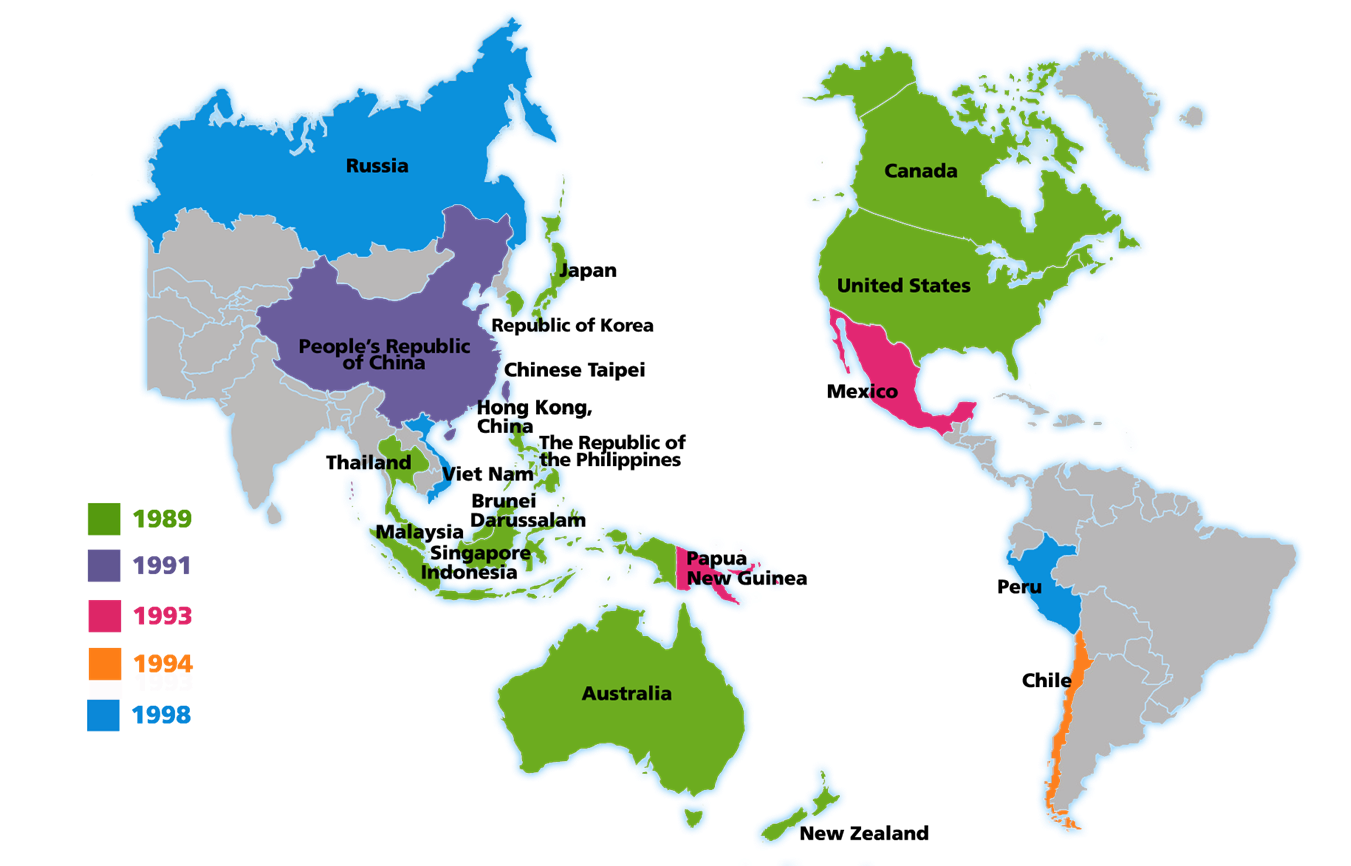
The Asia-Pacific Economic Cooperation (APEC) (opens in new tab) forum comprises 21 Asia-Pacific economies. It was established in 1989 in response to the growing interdependence among Asia-Pacific economies and the advent of regional trade blocs in other parts of the world. Its primary purpose is to promote economic growth and prosperity in the Asia-Pacific region. Singapore was a founding member alongside 11 other economies.
APEC's member economies are home to 38% of the world’s population and accounted for 62% of the world’s gross domestic product (GDP) in 2022. Over the last three decades, APEC’s real GDP growth rates have generally outpaced global averages.
Since its inception in 1989, trade in goods and services between APEC economies have more than tripled. From 1989 to 2023, the total value of APEC merchandise exports grew from USD $1.2 trillion to USD $11.7 trillion while the total value of imports increased by more than seven times, from USD $1.3 trillion to USD $11.8 trillion, amounting to around half the world’s merchandise exports and imports. A similar increasing trend is also seen in intra-APEC exports which has increased almost eight-fold from 1989 to 2021, from USD $0.9 trillion to USD $6.8 trillion. In 2022, APEC’s trade in goods and commercial services reached a total value of USD $30 trillion, amounting to 47% of global trade.
APEC operates on the basis of open dialogue and aims to strengthen regional economic integration by:
facilitating trade and investment "across the border";
removing supply chain chokepoints “at the border”; and
improving business climates "behind the border".
The focus of APEC’s work is connecting and integrating economies within the region so as to facilitate the ease of doing business within and between them. APEC leaders, ministers, senior officials and business representatives meet regularly to take the APEC agenda forward. APEC decisions are reached by consensus, and commitments are made on a voluntary basis. APEC supports the work of the World Trade Organization (WTO).
APEC Members
Australia | Brunei Darussalam | Canada |
Chile | China | Hong Kong China |
Indonesia | Japan | Republic of Korea |
Malaysia | Mexico | New Zealand |
Papua New Guinea | Peru | Philippines |
Russia | Singapore | Chinese Taipei |
Thailand | United States | Viet Nam |
Singapore in APEC
Over 78% of Singapore’s global trade in goods and services are with APEC economies. Singapore participates actively in APEC with a view to deepen economic integration in the region and strengthen economic linkages with individual APEC economies. APEC serves as a useful platform to share experiences and best practices as well as incubate fresh ideas and approaches on a variety of topics. These include areas in Singapore’s interest, such as trade facilitation, supply chain connectivity, digital economy, food security, and green economy, among others.
In 2009, Singapore chaired APEC under the theme of “Sustaining Growth, Connecting the Region”. Our chairmanship focused on recovering from the Great Financial Crisis by supporting the WTO, accelerating regional economic integration and strengthening the APEC institution. Singapore will be chairing APEC in 2030.
APEC 2026
China is the Chair of APEC 2026. The theme this year is “Building an Asia-Pacific Community to Prosper Together”. This theme embodies APEC’s commitment to create a better future for the next generation in accordance with the Putrajaya Vision 2040 which envisions an open, dynamic and resilient Asia-Pacific by 2040. Pillars of focus will be:
Openness: Supporting robust trade and investment in the region.
Innovation: Harnessing the opportunities offered by innovation and digitalisation.
Cooperation: Fostering sustainable growth and prosperity for all.