
Free Trade Agreements/Partnerships
Regional Comprehensive Economic Partnership (RCEP)
The RCEP is the world’s largest FTA, comprising about 30% of global GDP and about a third of the world’s population. It broadens and deepens Singapore’s economic connectivity with the region, opens up opportunities and provides businesses with more coherent access to the region.
About the Regional Comprehensive Economic Partnership (RCEP)
The Regional Comprehensive Economic Partnership (RCEP) is a Free Trade Agreement (FTA) between ASEAN Member States (Brunei Darussalam, Cambodia, Indonesia, Lao PDR, Malaysia, Myanmar, Philippines, Singapore, Thailand, Viet Nam), and its five FTA partners (Australia, China, Japan, Republic of Korea, and New Zealand). The RCEP entered into force on 1 January 2022.
The RCEP is the world’s largest FTA, comprising about 30% of global GDP and about a third of the world’s population. It broadens and deepens Singapore’s economic connectivity with the region, opens up opportunities and provides businesses with more coherent access to the region.
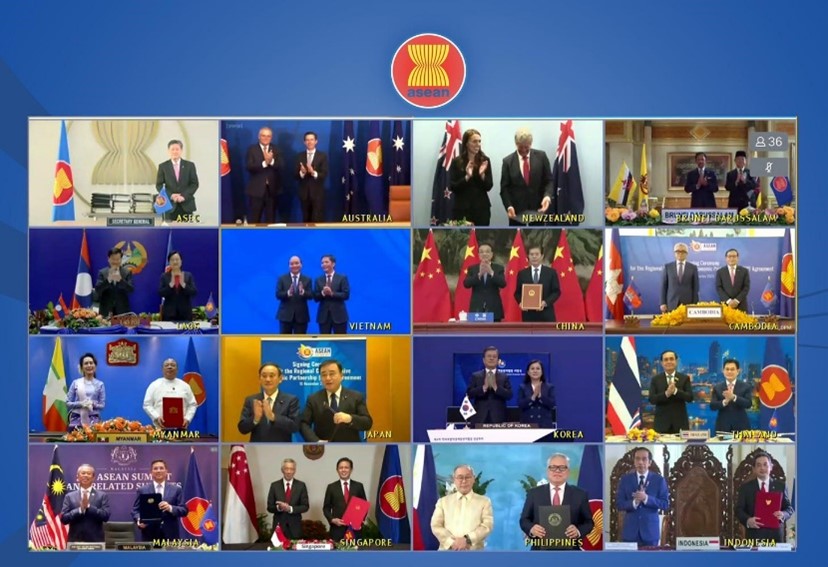
Economic Ministers signing the RCEP on 15 November 2020, witnessed by Leaders.
Key Features of the Regional Comprehensive Economic Partnership (RCEP)
Trade in goods
Market access. Eliminates tariffs for about 92% of Singapore's originating exports to other RCEP participating countries. Additional preferential market access vs ASEAN Plus One FTAs for specific products such as mineral fuels, plastics, chemical products, food preparations and beverages.
Trade facilitation. Enhanced provisions addressing non-tariff measures to bring down trade transaction costs for businesses, streamlined rules providing greater flexibility for companies to gain preferential market access benefits, and simplified procedures for more efficient clearance of goods.
Trade in services
Enhanced commitments on par or above existing ASEAN Plus One FTAs in research and development, business, professional services, computer and related services, and distribution and logistics services.
Investments
Investment Liberalisation, through reduced barriers to investment across ASEAN. Also sets requirements to provide non-discriminatory treatment of investments;
Investment Protection, which provides legal safeguards for investors of an RCEP Party and their investments in another RCEP Party, through requirements to provide Fair & Equitable Treatment and protections against expropriation;
Investment Facilitation, which aims to streamline and simplify investment rules and procedures; and
Investment Promotion, which aims to market ASEAN as an investment area.
E-commerce
Covers areas such as online consumer protection, online personal information protection, transparency, paperless trading and acceptance of electronic signatures.
Intellectual property
Greater protection for non-traditional trademarks and ensuring acceptance of a single patent or trademark application across RCEP Participating Parties, saving costs and time for businesses.
Competition
Inclusion of competition law regimes and cross-border enforcement cooperation to protect business from anti-competitive activities.
Government procurement
Increased transparency through publication of laws, regulations and procedures.
More Resources
Link to RCEP texts. (opens in new tab)