
Free Trade Agreements/Partnerships
ASEAN-Korea Free Trade Area (AKFTA)
The ASEAN-Korea Free Trade Area (AKFTA) eliminates tariffs for and facilitates trade in goods, services, and investments within ASEAN and the Republic of Korea (ROK).
About the ASEAN-Korea Free Trade Area (AKFTA)
The ASEAN – Korea Free Trade Area (AKFTA) is an FTA between ASEAN Member States (Brunei Darussalam, Cambodia, Indonesia, Lao PDR, Malaysia, Myanmar, Philippines, Singapore, Thailand, Viet Nam), and the Republic of Korea (ROK). Timor-Leste will officially accede to the AKFTA upon completing its required accession procedures. The AKFTA eliminates tariffs for and facilitates trade in goods, services, and investments within ASEAN and the Republic of Korea (ROK). It consists of the following agreements:
Trade in Goods Agreement: Entered into force in June 2007.
Trade in Services Agreement: Entered into force in May 2009.
Investments Agreement: Entered into force in September 2009.
The AKFTA Upgrade negotiations are ongoing. The Upgrade will ensure that the AKFTA is commercially meaningful and relevant to businesses and responsive to regional and global developments, through the enhancement of existing commitments and inclusion of new areas such as supply chain connectivity, energy cooperation, raw and intermediate materials, sustainable development and green economy, and digital economy.
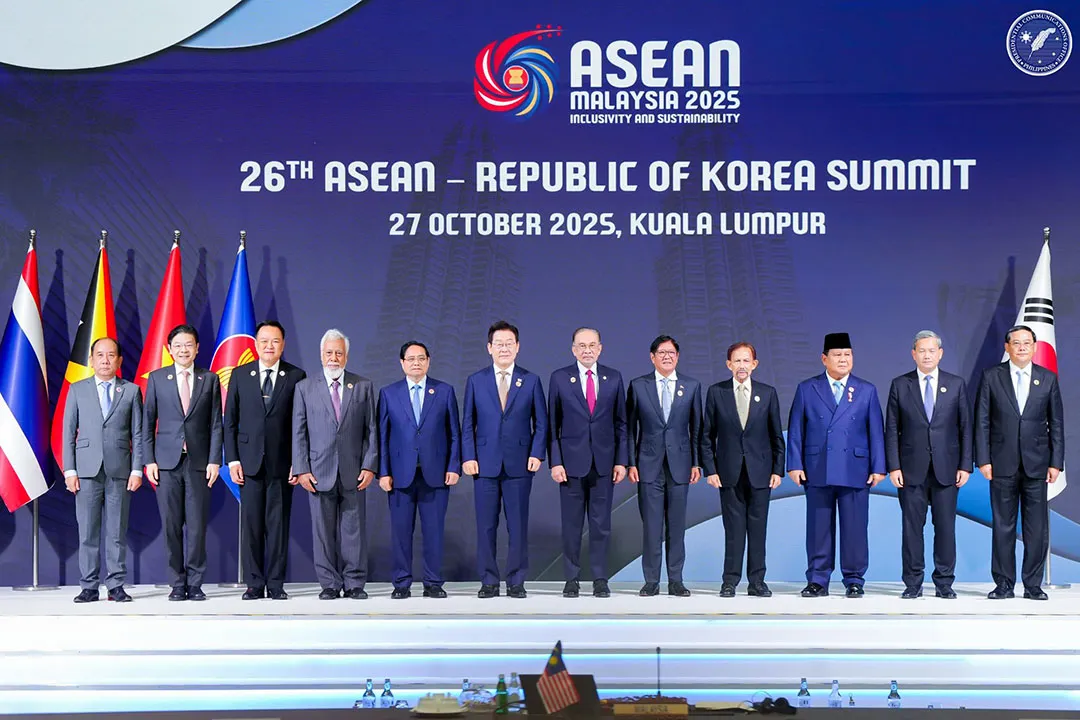
Leaders from ASEAN and ROK announced at the 26th ASEAN- ROK Summit on 27 October 2025 that the AKFTA Upgrade negotiations will commence in early 2026, upon the completion of respective domestic procedures.
Key Features of the AKFTA
Trade in goods
Market access. Eliminates tariffs for 91.1% of Singapore’s originating exports to ROK.
Regional cumulation. Imported Materials from other AKFTA Parties, that have been defined as originating based on the agreed percentage criterion, can be counted as originating from Singapore in the production of goods. This makes it easier for products exported from Singapore to qualify for preferential tariff treatment when exporting to other AKFTA Parties.
Back-to-back arrangement. AKFTA originating goods brought into Singapore and re-exported within AMS and ROK, without any processing in Singapore, can enjoy tariff concessions.
Third-party invoicing. Customs authorities may accept an invoice issued from a different country or company exporting the originating goods, provided that the goods meet the necessary requirements. This invoice can come from countries that are not party to this Agreement.
Trade in services
Improved market access in areas such as construction, education, communication, environmental, tourism, and transport services.
Investments
Investment Liberalisation, through reduced barriers to investment across ASEAN. Also sets requirements to provide non-discriminatory treatment of investments; and
Investment Protection, which provides legal safeguards for investors of an AKFTA Party and their investments in another AKFTA Party, through requirements to provide Fair & Equitable Treatment and protections against expropriation. Also provides for a legal mechanism for the resolution of investment disputes pertaining to the AKFTA, under which an investor of an AKFTA Party may pursue an arbitration claim against another AKFTA Party for breaches of the AKFTA’s investment provisions.
More Resources
Link to AKFTA texts. (opens in new tab)