
Free Trade Agreements/Partnerships
ASEAN-China Free Trade Area (ACFTA)
The ASEAN-China Free Trade Area (ACFTA) establishes a free trade area aimed at reducing trade barriers between China and ASEAN Member States (AMS).
About the ASEAN-China Free Trade Area (ACFTA)
The ASEAN – China Free Trade Area (ACFTA) is an FTA between ASEAN Member States (Brunei Darussalam, Cambodia, Indonesia, Lao PDR, Malaysia, Myanmar, Philippines, Singapore, Thailand, Viet Nam), and China. Timor-Leste will accede to the ACFTA upon completing its required accession procedures. The ACFTA establishes a free trade area aimed at reducing trade barriers between China and ASEAN Member States (AMS). It entered into force in 2010.
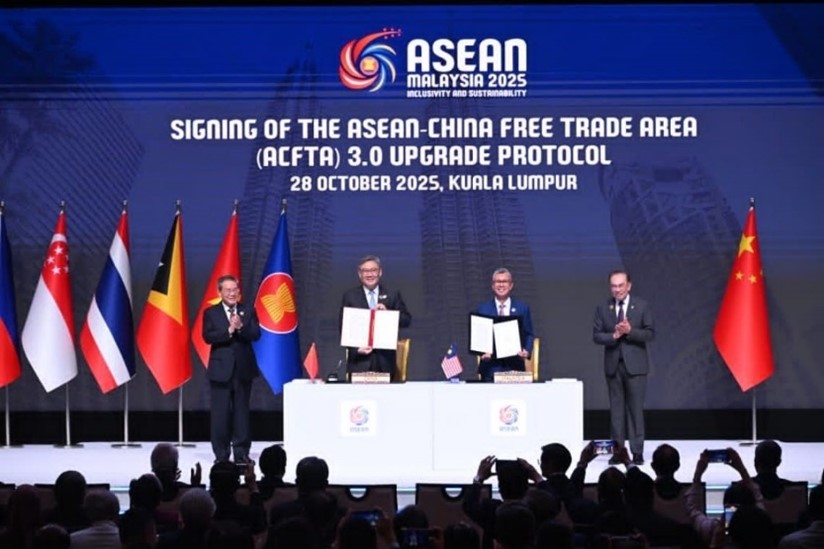
The second upgrade of the ACFTA (“ACFTA 3.0”) was signed in October 2025. It introduces new commitments in emerging areas, namely digital economy, green economy and supply chain connectivity. Enhanced commitments were also made on transparency and customs procedures, providing greater certainty and towards an increasingly seamless trading environment for businesses.
Key Features of the ACFTA (including the upgrades)
Market Access
Eliminates tariffs for 94.6% of Singapore’s originating exports to Japan.
Regional cumulation
Imported Materials from other ACFTA Parties, that have been defined as originating based on the agreed percentage criterion, can be counted as originating from Singapore in the production of goods. This makes it easier for products exported from Singapore to qualify for preferential tariff treatment when exporting to other ACFTA Parties.
Back-to-back arrangement
ACFTA originating goods brought into Singapore and re-exported within AMS and China, can enjoy tariff concessions.
Third-party invoicing
Customs authorities may accept an invoice issued from a different country or company exporting the originating goods, provided that the goods meet the necessary requirements. This invoice can come from countries that are not party to this Agreement.
Enhanced transparency and customs procedures
Greater transparency in health, safety and product regulations for food, animals, and other products. Companies will also benefit from expedited and simplified customs procedures, minimising potential disruptions.
Three new chapters on key emerging areas
Supply chain connectivity. Greater certainty in continued trade of essential goods during crises. Businesses can look forward to enhanced connectivity between China and ASEAN through business matching, pilot projects and initiatives, emergency transport requests, etc;
Digital economy. More seamless cross-border digital trade and data flows, which will save time and costs for SMEs in particular. Businesses can tap on new opportunities from cooperation on emerging technologies such as Artificial Intelligence and Fintech; and
Green economy. Deeper cooperation in green economy, such as in addressing market barriers for environmental goods and services.
New commitments on competition and consumer protection
Stronger rules against unfair or anti-competitive business practices, and better protection for online and overseas consumers. For example, through promoting redress mechanisms for overseas consumers.
Investment
Improved Liberalisation, through reduced barriers to investment across ASEAN. Also sets requirements to provide non-discriminatory treatment of investments;
Investment Protection, which provides legal safeguards for investors of an ACFTA Party and their investments in another ACFTA Party, through requirements to provide Fair & Equitable Treatment and protections against expropriation. Also provides for a legal mechanism for the resolution of investment disputes, under which an investor of an ACFTA Party may pursue an arbitration claim against another ACFTA Party for breaches of the ACFTA Investment Chapter;
Investment Facilitation, which aims to streamline and simplify investment rules and procedures; and
Investment Promotion, which aims to market ASEAN as an investment area.
More Resources
Link to ACFTA texts. (opens in new tab)