
Free Trade Agreements/Partnerships
ASEAN-Australia-New Zealand Free Trade Area (AANZFTA)
The ASEAN-Australia-New Zealand Free Trade Area (AANZFTA) was upgraded in August 2023 and entered into force on 21 April 2025. It contains newer provisions, on supply chain resilience, ecommerce, and a standalone Chapter on Trade and Sustainable Development. Enhanced commitments were made in e-commerce, rules of origin, investment, services, consumer protection, and government procurement.
About the ASEAN-Australia-New Zealand Free Trade Area (AANZFTA)
The ASEAN-Australia-New Zealand Free Trade Area (AANZFTA) is an FTA between ASEAN Member States (Brunei Darussalam, Cambodia, Indonesia, Lao PDR, Malaysia, Myanmar, Philippines, Singapore, Thailand, Viet Nam), Australia, and New Zealand. Timor-Leste will officially accede to the AANZFTA upon completing its required accession procedures.
The AANZFTA encompasses areas such as intellectual property, competition and electronic commerce. It entered into force in January 2010.
The AANZFTA was upgraded in August 2023 and entered into force on 21 April 2025. It contains newer provisions, on supply chain resilience, ecommerce, and a standalone Chapter on Trade and Sustainable Development. Enhanced commitments were made in e-commerce, rules of origin, investment, services, consumer protection, and government procurement.
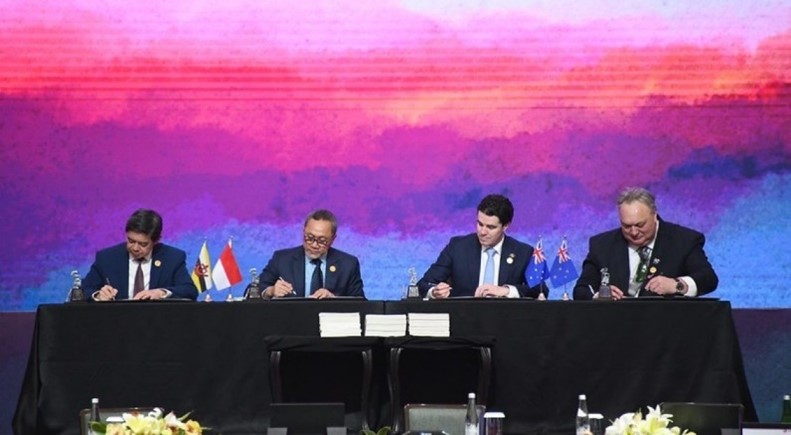
Economic Ministers from Australia, New Zealand, and ASEAN signing the Second Protocol to amend the AANZFTA on 21 August 2023.
Key Features (including the upgrades)
Trade in goods
Trade facilitation. AANZFTA Parties to refrain from introducing restrictions on essential goods, as well as facilitate expedited movement, release and clearance of essential goods during crises;
Full cumulation. When implemented, easier for final products of businesses to qualify as originating and enjoy preferential tariff treatment when exporting to other AANZFTA Parties. Also allows business greater flexibility in sourcing inputs from other AANZFTA Parties;
Back-to-back arrangement. AANZFTA originating goods brought into Singapore and re-exported within AMS, Australia, and New Zealand, can enjoy tariff concessions; and
Third-party invoicing. Customs authorities may accept an invoice issued from a different country or company exporting the originating goods, provided that the goods meet the necessary requirements. This invoice can come from countries that are not party to this Agreement.
Enhanced trade in services
Clearer and more business-friendly domestic regulations, especially for telecommunication services providers, education and professional services.
E-commerce
New areas of cooperation such as digital trade standards and e-invoicing.
Investments
Investment Liberalisation, through reduced barriers to investment across ASEAN. Also sets requirements to provide non-discriminatory treatment of investment; and
Investment Protection, which provides legal safeguards for investors of a AANZFTA Party and their investments in another AANZFTA Party, through requirements to provide Fair & Equitable Treatment and protections against expropriation. Also provides for a legal mechanism for the resolution of investment disputes, under which an investor of an AANZFTA Party may pursue an arbitration claim against another AANZFTA Party for breaches of the AANZFTA Investment Chapter.
Competition
Includes comprehensive coverage of consumer protection, to provide companies better protection from anti-competitive activity when operating in the ASEAN region.
Trade and sustainable development
Improved access to green opportunities through cooperation, information sharing and capacity building among AANZFTA parties.