
Free Trade Agreements/Partnerships
ASEAN - Free Trade Area (AFTA)
The ASEAN-Free Trade Area (AFTA) eliminates tariffs for and facilitates trade in goods, services, and investments within the ASEAN region.
About the ASEAN - Free Trade Area (AFTA)
The ASEAN Free Trade Area (AFTA) was established in 1992 between ASEAN Member States (Brunei Darussalam, Cambodia, Indonesia, Lao PDR, Malaysia, Myanmar, Philippines, Singapore, Thailand, and Viet Nam). Timor-Leste will officially accede to the AFTA upon completing its required accession procedures.
The AFTA consists of three agreements which eliminate tariffs for and facilitate trade in goods, services, and investments within the ASEAN region.
ASEAN Trade in Goods Agreement (ATIGA): Entered into force in 2010. ASEAN welcomed the signing of the Upgraded ATIGA in October 2025. The upgraded Agreement will need to be ratified by ASEAN member states. The Upgraded ATIGA introduces new commitments in emerging areas, namely the green economy and supply chain connectivity. Enhanced commitments were also made on market access, rules of origin, transparency and customs procedures, providing greater certainty and to move the ASEAN region towards an increasingly seamless regional trading environment for businesses.
ASEAN Trade in Services Agreement (ATISA): Builds upon and enhances the existing ASEAN Framework Agreement on Services (AFAS). Entered into force in 2021.
ASEAN Comprehensive Investment Agreement (ACIA): Entered into force in 2012.
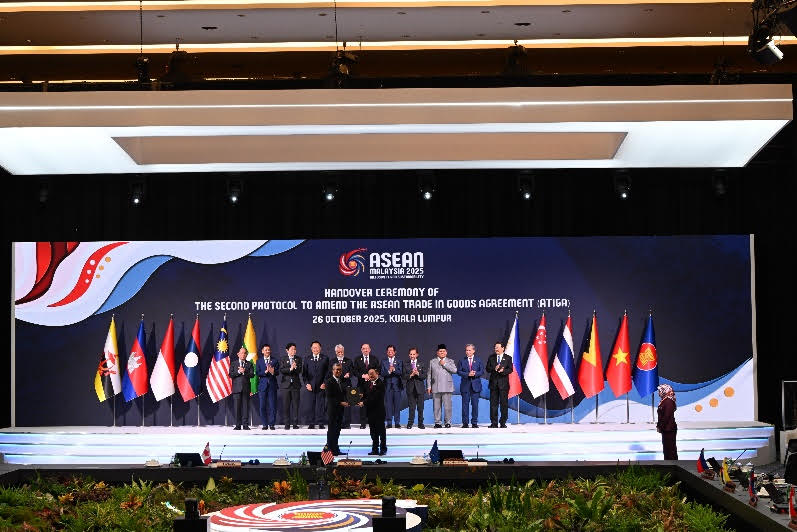
ASEAN Leaders and Economic Ministers welcomed the signing of the Second Protocol to Amend the ATIGA at a handover Ceremony at the sidelines of the 47th ASEAN Summit on 26 October 2025.
Key Features of the AFTA
Upgraded ATIGA
Improved market access
Eliminates tariffs for 98.89% of Singapore’s originating exports to other ASEAN Member States, with further tariff liberalisation in agricultural products, cotton, and vehicles, amongst others, opening doors for more regional trade and growth.
Regional cumulation
Imported Materials from other ASEAN Member States (AMS), that have been defined as originating based on the agreed percentage criterion, can be counted as originating from Singapore in the production of goods. This makes it easier for products exported from Singapore to qualify for preferential tariff treatment when exporting to other ASEAN Member States.
Back-to-back arrangement
ASEAN originating goods brought into Singapore can enjoy preferential tariff treatment concessions when re-exported within AMS.
Third-Party invoicing
Customs authorities may accept an invoice issued from a different country or company exporting originating goods, provided that the goods meet the necessary requirements. This invoice can come from countries that are not party to this Agreement.
Improved rules of origin
More trade facilitation rules of origin in key sectors such as electronics and chemicals.
Enhanced trade facilitation
Companies will benefit from faster customs clearance, clearer and fairer rules to prevent the misuse of tools/measures used by governments to protect domestic industries from unfair or harmful international trade practices such as dumping, subsidies, and circumvention.
Enhanced transparency
Greater transparency in health, safety and product regulations for food, animals, and other products.
New commitments on supply chain connectivity
Stronger protections to ensure continued flows of essential goods and opportunity to establish a crisis response platform, to strengthen supply chain resilience for companies during crises.
New commitments on sustainability
Cooperation to lower trade barriers on environmental goods and facilitating trade of remanufactured goods among ready AMS.
AFAS/ATISA
Market access
Provides the widest preferential access for service suppliers in the region, covering 111-122 sectors. Also improves transparency and reduces discriminatory regulatory barriers, providing greater certainty to businesses and a more predictable environment.
ACIA
Scope covering five sectors: Manufacturing, Agriculture, Fishery, Forestry, Mining and Quarrying, as well as services incidental thereto.
The ACIA comprises four pillars:
Investment Liberalisation, which provides legal safeguards for investors of an ASEAN Member State (AMS) and their investments in another AMS, through requirements to provide Fair & Equitable Treatment and protections against expropriation. Also provides for a legal mechanism for the resolution of disputes between an investor of an AMS and an AMS, under which an investor may pursue claims against an AMS that breaches its commitments in the ACIA;
Investment Facilitation, which aims to streamline and simplify investment rules and procedures; and
Investment Promotion, which aims to market ASEAN as an investment destination.
More Resources
Link to the AFTA legal texts. (opens in new tab) *
For more information on the key benefits of the upgraded ATIGA, see METI's infographic and factsheet in the press release.
*The text of the Upgraded ATIGA will be published once all AMS have signed the upgrade Agreement.